Clarity Is a Budget Strategy
The most expensive design mistake usually starts with “we’ll figure that out later.”
The most expensive design mistake rarely looks expensive at first. It sounds harmless.
“We’ll figure that out later.”
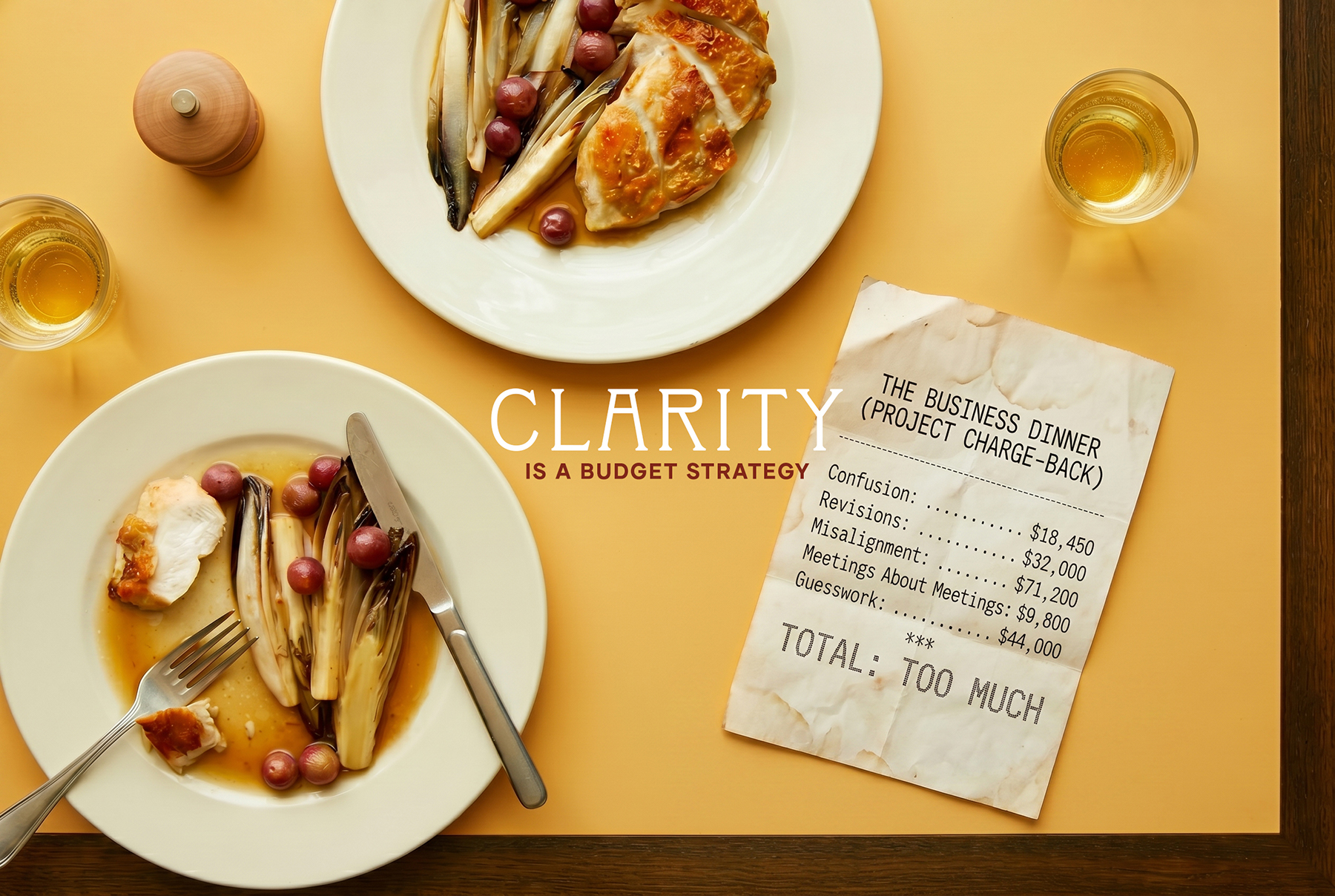
Later is where budgets go to die. It’s where a vague concept becomes five rounds of revisions, the furniture package starts drifting, and the team keeps reopening decisions everyone thought were already solved.
That is the cost of ambiguity.
Not just creative confusion. Actual cost.
Vague concepts create expensive decisions.
When a project does not have a clear point of view, every decision becomes a debate.
What should this feel like? Who is this for? Is this too elevated? Is this too casual? Should the menu sound playful or refined? Does this material belong? Is this detail worth the money?
Without clarity, those questions do not get answered once. They get answered over and over again.
In meetings. In emails. In late-stage revisions. In the field. Under pressure. With money already committed.
That is where projects get expensive.
Not because people lack taste. Because taste is being asked to make decisions that strategy should have made earlier.
Good taste still needs a filter.
Nice options are not the same as right options.
A beautiful tile can still be wrong. A great light fixture can still not belong. A clever brand line can still pull the concept off course. A stunning chair can still slow service. A dramatic material can still age badly.
Clarity gives the team a filter.
It tells you what belongs, what does not, where to spend, where to simplify, and which ideas are good but not good for this project.
That distinction saves money.
It also saves the work from becoming a collection of impressive parts that never become a whole.
Ambiguity shows up everywhere.
A vague concept does not stay contained.
It leaks.
It shows up in the floor plan, the finishes, the logo, the menu, the photography, the music, the uniforms, and the guest experience.
That is why unclear direction becomes so expensive. It does not create one problem. It creates a thousand tiny ones.
Too many references. Late changes. Unclear approvals. Finishes that do not support the story. Signage added too late. A brand voice that sounds disconnected from the room. Interiors that look good but do not support operations.
The project starts spending money to solve symptoms instead of addressing the real issue.
The concept was not clear enough early enough.
Clarity protects the work.
A clear concept is not a creative restriction.
It is protection.
It protects the budget from preference-based decisions. It protects the timeline from unnecessary revisiting. It protects the design from trend-chasing. It protects the team from opinion fatigue. It protects the guest experience from feeling scattered.
When the concept is clear, the team has something to return to.
- Does this support the story?
- Does this improve the experience?
- Does this earn its cost?
- Does this still make sense when the room is full?
- Does this help the place become more itself?
Those questions are cheaper to ask early.
Much cheaper.
The Saint Iris approach
At Saint Iris, we help define the concept early so the entire project has something solid to stand on.
We take the references, ambitions, constraints, audience, business goals, and emotional intent, then turn them into a clear creative direction the team can actually use.
Not just a pretty deck.
A filter. A set of boundaries. A point of view. A language for decisions. A way to keep the main thing the main thing when the project gets real.
Because clarity does not make a project less creative.
It makes the right creative decisions easier to protect.